Banner Template

Beer, Brewing and Better Conversations: Our Latest Women’s Networking Evening

On 11 November, Digby Associates once again partnered with Barclays to bring professional women together for an evening of conversation, new connections and, this time, a little beer tasting.

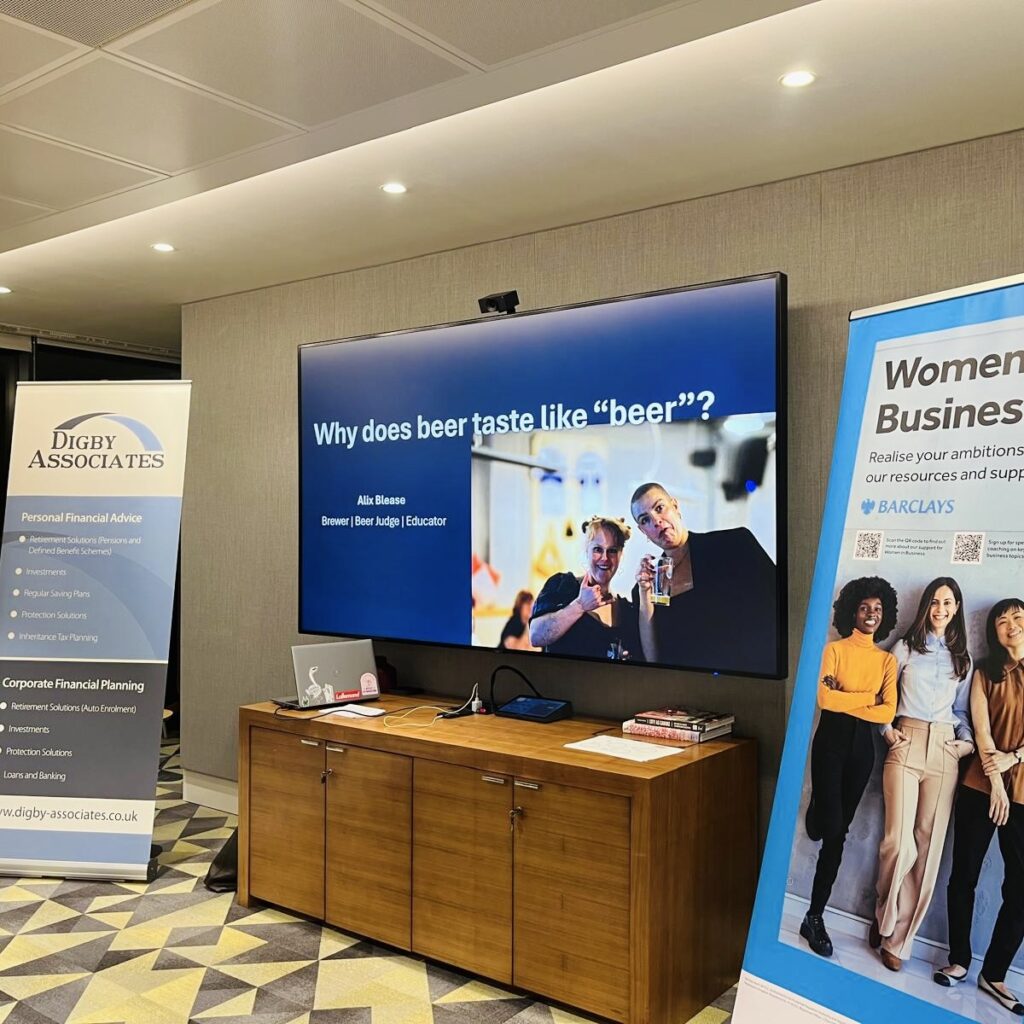
For our latest Women’s Networking Evening, we were delighted to welcome Alix Blease, Professional Brewer at Lallemand Brewing, who gave guests a fascinating introduction to the science, history and culture behind one of the world’s oldest drinks.

It was a slightly different take on the traditional networking event, and that was very much the point.


Four beers, and a lot more to learn

Throughout the evening, guests tasted four very different styles of beer: lager, IPA, stout and sour. Alix talked us through what makes each distinctive, explaining how changes in ingredients and the brewing process can produce dramatically different flavours, aromas and characteristics.

We explored the fundamental ingredients that go into beer, including water, malt, hops and yeast, and how adjusting those ingredients can change everything from bitterness and colour to strength and texture. Alix also explained the importance of how beer is stored, served and poured.

It was a reminder that something as familiar as a pint of beer can have an extraordinary amount of science and craftsmanship sitting behind it.



Women and the history of brewing

One of the most interesting parts of the evening was learning about the role women have played in the history of brewing.

For centuries, brewing was often carried out domestically and women played an important role in producing and selling beer. Alix explored some of the imagery that has become associated with those early brewers, from large brewing cauldrons to broomsticks used to signal that beer was available, an early form of advertising that has echoes in the pub signs we still recognise today.

She also touched on the fascinating associations that later developed between female brewers and some of the imagery we now associate with witches, giving everyone a very different perspective on a familiar piece of folklore.

An unexpected history lesson alongside the beer tasting, and one of the topics that generated plenty of conversation around the room.



Changing tastes

The evening also looked at how our relationship with beer continues to change.

While overall beer consumption has evolved over time, the range of styles available today has expanded enormously. Craft brewing, alcohol-free alternatives and greater experimentation with flavours have all changed what consumers expect, while beer is increasingly attracting audiences who may historically have felt overlooked by traditional beer marketing.

That included a discussion about the growing number of women enjoying and engaging with beer, and how the industry itself is becoming more diverse.

As with so many consumer markets, tastes change, expectations change and businesses have to change with them.



Networking without the name badges and awkward introductions

There was another reason the evening worked so well.

Networking does not have to mean walking into a room, collecting as many business cards as possible and making small talk with strangers.

Giving people something interesting to experience together immediately changes the atmosphere. Instead of having to find something to talk about, there is already a shared conversation happening in the room.

That is something we have tried to build into our Women’s Networking events. The aim is to create an informal environment where people can meet others from different businesses and professions, share experiences and hopefully leave having learnt something new as well.

On this occasion, they may also have left knowing considerably more about the correct way to pour a pint.

Twenty-nine pubs for further research

Alix finished the evening by giving guests a map featuring 29 of Bristol’s best pubs, providing plenty of inspiration for anyone keen to continue their newfound beer education.

Purely for research purposes, of course.

Thank you

A huge thank you to Alix for such an engaging and informative session, to Barclays Wealth Management for partnering with us once again, and to everyone who joined us and helped make the evening such an enjoyable one.

We love creating opportunities for people to meet, learn from one another and make new connections is an important part of these events.

And if that conversation happens over a lager, IPA, stout or sour, all the better.

interest rates

Interest Rates Are Rising Again. What Does That Actually Mean for Your Money?

For much of the past year, expectations around interest rates had generally focused on the possibility of further falls. More recently, however, renewed inflationary pressures have changed the outlook.

Against this backdrop, the Bank of England has increased Bank Rate from 3.75% to 4%, its first increase in more than three years. The decision comes as inflation has moved back up to 3.6% in October, with higher energy and fuel costs adding renewed pressure to household budgets.

It is an important change, but perhaps the more interesting point is how quickly expectations can shift.

Only a relatively short time ago, attention was focused on how quickly borrowing costs might come down. Now households, businesses and financial markets are once again asking how high rates might need to go.

That uncertainty is a useful reminder that financial plans should rarely depend on predicting exactly what interest rates will do next.

Why has the Bank raised rates?

The Bank of England has one primary objective when setting interest rates: keeping inflation at its 2% target over the medium term.

Higher interest rates make borrowing more expensive and generally encourage people to save rather than spend. Over time, that can reduce demand in the economy and make it more difficult for businesses to continue increasing prices.

The Bank provides a useful explanation of how changes in interest rates feed through into inflation, borrowing and saving.

The current problem is that inflation has been moving in the wrong direction again. Higher global energy costs have contributed to UK inflation reaching 3.6%, while the Bank has become increasingly concerned about the possibility that those higher costs could feed into wages and prices elsewhere in the economy.

Raising Bank Rate is therefore intended to prevent that temporary inflationary pressure from becoming more persistent.

For mortgage borrowers, the important rate may not be Bank Rate

A rise in Bank Rate naturally attracts attention from homeowners, but the effect depends heavily on the type of mortgage someone has.

People on tracker mortgages are likely to see the impact relatively quickly because their rate moves in line with Bank Rate. Those on fixed-rate mortgages will generally see no immediate change to their monthly payment.

The bigger issue for many households comes when an existing fixed deal ends.

According to UK Finance, around 2.3 million fixed-rate mortgage deals are due to expire during 2027, and many took those mortgages when borrowing costs were considerably lower. For those households, the difference between their existing deal and the rate available when they remortgage could matter much more than the quarter-point increase by itself.

It is another example of why the headline number does not necessarily tell you what will happen to your own finances.

Savers may see some benefit, but don’t assume every rate will move

Higher Bank Rate can be good news for savers because banks and building societies may increase the rates they offer on savings accounts.

But there is no requirement for providers to pass on the full increase, and different accounts can move at very different speeds. The Bank of England itself notes that Bank Rate influences savings and borrowing rates but is not the only factor determining them.

That means it remains worth checking what your cash is actually earning rather than assuming that an account which was competitive a year ago is still competitive today.

There is also the wider question of what that cash is for. Money required in the near future may quite reasonably belong in an accessible savings account. Money intended for a goal 10 or 20 years away has a very different job to do.

What about investments?

Interest-rate decisions can also affect investment markets, although rarely in a simple or predictable way.

Higher borrowing costs can affect company profits, property, currencies and bond markets, while expectations about future rates are often reflected in market prices before the Bank actually makes its decision.

That last point is particularly important. Markets do not simply react to what happened today. They are constantly trying to anticipate what might happen tomorrow.

For an individual investor, trying to reposition a long-term portfolio every time expectations around interest rates change can therefore become an exhausting exercise.

The purpose of a long-term financial plan is partly to avoid having to make every decision on the basis of the latest economic headline.

Investments are designed to help grow your money for the future over the longer term. You should keep in mind that investments are exposed to market movements, meaning values can go down as well as up, and you may not receive back the full amount invested.

One rate rise doesn’t tell us where rates are going

The Bank of England’s decision to raise Bank Rate does not necessarily mark the start of a long series of increases.

The outlook remains unusually uncertain. Energy prices, inflation, wage growth, economic activity and events overseas could all influence what the Bank does over the coming months.

Indeed, while the Bank raised interest rates, financial markets have spent much of this year repeatedly changing their expectations about what will happen next.

That is why basing a long-term financial decision on a precise prediction about interest rates can be difficult.

Nobody knows with certainty whether Bank Rate will be higher, lower or roughly where it is today a year from now.

What we can plan for is the possibility that circumstances change.

Build a plan that doesn’t require a perfect forecast

For somebody with a mortgage, that could mean understanding what a higher rate would do to monthly expenditure before the current deal ends.

For a saver, it might mean making sure cash is earning a competitive return and considering whether all of it genuinely needs to remain in cash.

For somebody investing over decades, it may simply mean resisting the temptation to repeatedly change course because the economic outlook has shifted again.

And for someone approaching retirement, it can mean considering how cash, investments, pensions and other sources of income work together rather than treating each in isolation.

Those are quite different decisions, but they have something in common: none requires us to know exactly where Bank Rate will be next year.

The direction changed. Your goals probably didn’t.

Interest rates matter. They affect mortgages, savings, investments, businesses and ultimately the wider economy.

But most people’s financial objectives are considerably more stable.

You may still want to retire at a particular age, help your children, move home, travel more or create greater financial security for your family. Interest-rate decisions may affect the route towards those goals, but they probably haven’t changed the goals themselves.

That is perhaps the more useful way to think about the announcement.

Not simply:

“Rates have gone up. What should I do?”

But:

“Does this change anything that genuinely matters to my plan?”

Sometimes the answer will be yes.

Quite often, it will simply mean making sure the plan is flexible enough to cope when the economic weather changes again.

banner - lewis

From Office Junior to Financial Adviser: Lewis Brain’s 18 Years at Digby Associates

When Lewis Brain joined Digby Associates in April 2008, he had just finished sixth form and was starting out as an office junior.

Eighteen years later, he is a financial adviser helping clients plan for retirement, manage their investments and think about increasingly complex areas across their finances. His career has taken him through almost every layer of the business along the way.

At a time when young people are often presented with a daunting picture of the job market, Lewis’s story is a useful reminder that careers do not always begin with a perfectly mapped-out plan. Sometimes they begin by getting through the door, learning how a business works and being prepared to build from there.

Choosing work over university

Lewis had already completed work experience with Digby Associates, as well as a placement at Barclays, before finishing sixth form. He had studied Business alongside IT and technology, but knew that university was not the route he wanted to take.

“I’d studied Business at school along with IT and tech, three subjects that have probably become more useful than ever,” he says. “All three intertwine to make our industry what it is today.”

His first role at Digby Associates involved the kind of jobs familiar to many people starting their careers. As an office junior, Lewis spent several years learning the basics before gradually taking on more responsibility.

That foundation turned out to matter.

“I think understanding the roles as you progress is really important,” he says. “Everyone has to start somewhere, and if that means starting at the bottom, that’s ok, as it’s important to understand things from the ground up.”

It is an idea that feels particularly relevant today. The route from education into work is becoming broader than the traditional school-university-graduate-job path. The Government is currently expanding support for technical education and apprenticeships, including plans intended to create 50,000 additional youth apprenticeships, while professional bodies such as the Chartered Insurance Institute now offer structured routes into financial services for school leavers and people without previous industry experience.

Learning the business from the ground up

Lewis’s own progression was gradual. After working as an office junior, he moved into producing client valuations and managing colleagues diaries before progressing into paraplanning, where he helped prepare new business cases for Digby and other advisers.

Then, in 2017, came the opportunity that changed the direction of his career.

Digby Associates supported Lewis through Financial Adviser School, beginning the journey towards becoming an adviser himself.

“Had that not come about, I wouldn’t be doing the role I do today,” he says. “I’m the type of learner who needs to be taught through discussions and visual learning. I’m not the type to pick up a book and just soak up the information.”

That is perhaps another useful lesson for people entering work. Development does not have to look the same for everyone. Some people thrive academically, others learn by doing, and many develop most quickly through a combination of practical experience, professional qualifications and learning from the people around them.

There are now formal routes that reflect that too. The CII’s Level 4 Financial Adviser apprenticeship, for example, combines employment, training and the Diploma in Regulated Financial Planning, and can be used by people entering the profession as well as those progressing from administrative or paraplanning roles.

The value of learning from different generations

Ask Lewis about the biggest thing he has learnt during his career and he comes back to people.

“Listen to people who have done it before,” he says. “Even if they don’t do the same role now, they have lived and breathed it and the passing down of that knowledge is invaluable.”

He points to Digby Player, Paul Flower, Gary Stoker, Paul Watkins and James Long among those who have supported his development over the years.

That mix of experience is an important part of Digby Associates today. We have colleagues at different stages of their careers, from people beginning their journey in financial services through to advisers and members of the team with decades of experience behind them. Bringing those perspectives together means younger colleagues can learn from people who have seen markets, regulation and client needs change over many years, while newer generations bring different experiences, skills and ways of thinking to the business.

For Lewis, one lesson has remained consistent throughout: clients come first.

“Communicating with clients is key,” he says. “They are what keep all of us in jobs, and if those relationships aren’t managed appropriately then there won’t be any business to manage.”

A career that continues to change

One of the things Lewis still enjoys most is the variety.

No two weeks necessarily look the same. He might spend several days visiting clients, work from the office, spend time working from home or be dealing with very different financial planning challenges from one meeting to the next.

For Lewis, some of the most rewarding conversations are those where financial planning allows somebody to do something they had not thought possible, perhaps retiring earlier than expected or understanding how much income they can comfortably take in retirement. More recently, he has also been helping clients think about protecting family wealth as the Inheritance Tax landscape becomes increasingly important.

That changing nature of the job is also part of what makes financial services an interesting career for younger people. It combines technical knowledge with technology, regulation, communication and, above all, relationships with people.

It is not simply a job about numbers.

“Have confidence in your own ability”

Lewis’s advice to someone leaving school or college is refreshingly straightforward.

“Try different things and work in different places. If it means starting at the bottom, accept that everyone has to at some point. And try not to progress too quickly either, because understanding the roles as you move forward is a really important skill.”

He also encourages young people to make the most of professional qualifications where they are available, while being realistic about the commitment involved. Exams often require work outside normal hours, so finding an area you genuinely enjoy matters.

And if he could give his 18-year-old self one piece of advice?

“Be more confident in your own ability.”

Eighteen years, and still looking forward

Lewis’s career has changed enormously since he first walked into Digby Associates as an office junior in 2008, but in many ways his story reflects what we want a career here to be able to offer: the opportunity to learn, take on responsibility, gain professional qualifications and develop at a pace that works for the individual.

There is understandably plenty of discussion about the challenges facing young people entering the workforce. But there are also opportunities to build meaningful careers through routes that may not always be obvious at school or college.

You do not necessarily need to know exactly where you want to end up when you start.

Lewis certainly did not join Digby Associates at 18 with an 18-year career plan mapped out in front of him. He started with an opportunity, learnt from the people around him and kept moving forward.

And nearly two decades later, he is still doing exactly that.

budget round up

Budget 2026: The Headline Rates Stayed Put. The Incentives Didn’t.

Budgets are often judged by the biggest number in the Chancellor’s speech. Did Income Tax go up? Was there a new levy? What happened to pensions? Who gained and who lost?

But the interesting thing about John Healey’s first Budget is that some of the most important changes sit beneath those headline questions.

The main rates of Income Tax remain at 20%, 40% and 45%, and the Personal Allowance stays at £12,570. Yet from April 2027, the way some other forms of income are taxed will change, while the Government has also altered its approach to ISAs, first-time buyers and lower-income pensioners.

So rather than asking simply whether taxes went up or down, perhaps the more useful question is:

What is the Budget encouraging us to do differently with our money?

Saving outside an ISA becomes a little less attractive

One of the clearest changes concerns savings interest.

From 6 April 2027, the Income Tax rates applying to savings income will rise by four percentage points, taking the basic savings rate to 24%, the higher rate to 44% and the additional rate to 49%. The Personal Savings Allowance and starting rate for savings remain unchanged.

That matters particularly at a time when higher interest rates mean more people are earning meaningful amounts of interest on cash.

Someone can quite reasonably look at a savings account paying an attractive rate and feel their money is working hard. But once savings exceed the relevant tax-free allowances, the return after tax becomes increasingly important too.

At the same time, the Government has decided to retain the £20,000 ISA allowance, including the £20,000 Cash ISA limit, rather than proceeding with the previously proposed reduction in the amount younger savers could hold in cash ISAs. It is also exploring a future incentive for people investing through a Stocks and Shares ISA for the first time.

That combination is interesting. The Government is not forcing savers out of cash, but it is making the tax shelter provided by an ISA potentially more valuable for people with larger cash balances.

Landlords face a similar calculation

Property income is also being separated from the standard Income Tax rates.

From April 2027, property income will be taxed at 24%, 44% and 49% at the basic, higher and additional rates respectively. The Government says the measure is intended to help fund its wider support for households and businesses.

For landlords, that adds another factor to an already complicated calculation involving mortgage costs, maintenance, regulation and the eventual tax treatment of any property sale.

It does not suddenly make property a good or bad investment. But it reinforces a broader point: the return that matters is rarely the headline return. What you keep after tax, costs and inflation is usually much more relevant.

The £20,000 ISA survives

Before the Budget, there had been considerable discussion about reducing the Cash ISA allowance. That did not happen.

The Government confirmed that the annual ISA subscription limit will remain £20,000 for 2027/28, while the Junior ISA and Child Trust Fund limits remain at £9,000.

That may sound like an absence of change, but sometimes what a Budget leaves untouched is important too.

ISAs remain one of the simplest ways of shielding savings and investment returns from Income Tax and Capital Gains Tax. With tax on savings income increasing outside those wrappers, using available allowances appropriately may become even more relevant.

Of course, whether cash or investments are suitable within an ISA depends on what the money is for, when it might be needed and the level of risk someone is comfortable taking.

A change for first-time buyers

There was also movement on Lifetime ISAs.

From 29 October 2026, someone using a Lifetime ISA to buy a first home costing more than the current £450,000 property cap will face a 20% withdrawal charge rather than 25%. The property price limit itself has not changed.

Further ahead, the Government plans to introduce a new First Time Buyer ISA from April 2029, replacing Lifetime ISAs for new savers. Existing Lifetime ISA holders will still be able to continue using their accounts under the existing rules.

For younger savers, it is therefore another reminder that the vehicle used to save for a home can matter almost as much as the amount being saved.

Some pensioners get a little breathing room

The Budget also addressed an awkward problem created by the interaction between the State Pension and the frozen Personal Allowance.

From April 2027, a new Pension Tax Allowance will mean people above State Pension age whose total income is no greater than the value of the full new State Pension will not be brought into paying a small amount of Income Tax simply because the State Pension has risen above the Personal Allowance. The relief will taper away for people with slightly higher incomes and is currently intended to run through to 2029/30.

It is quite a technical solution to a technical problem, but potentially a welcome one for pensioners with relatively modest incomes.

The bigger pension and Inheritance Tax change is still coming

One thing the Budget did not reverse is the major change already scheduled for April 2027.

From 6 April 2027, most unused pension funds and pension death benefits will form part of an estate for Inheritance Tax purposes. The Budget made some technical amendments around how the tax will be administered, but the underlying reform remains in place.

For families with significant pension assets, that remains one of the most important planning changes on the horizon.

It also demonstrates why looking at a Budget in isolation can sometimes be misleading. Some of the biggest changes affecting people over the next few years were announced previously and are simply continuing on their journey towards implementation.

And some help will be felt much sooner

Not everything in the Budget was about long-term tax planning.

The Government announced a £100 Household Energy Payment for households in Council Tax bands A to D in England, alongside plans to remove standing charges from domestic gas bills. It also extended other cost-of-living measures as part of what it described as providing households with some immediate “breathing space”.

Those measures may be more immediately noticeable for many households than some of the tax changes that take effect next April.

The Budget’s quieter message

Taken together, the Budget feels less like a wholesale rewrite of personal finances and more like a series of nudges.

Keep more savings within tax-efficient wrappers where appropriate.

Think carefully about the after-tax return on cash and property.

Recognise that pensions are increasingly being returned to their original purpose of funding retirement rather than acting primarily as an estate-planning vehicle.

And, as ever, pay attention not only to what changed, but to what stayed the same.

The danger after any Budget is to react to each announcement separately. A new tax rate can make one option look less attractive, while an unchanged allowance can make another look more valuable. But financial planning works best when those pieces are considered together.

The right response is therefore unlikely to be to reorganise everything because the Chancellor has spoken.

It is to ask whether the Budget has changed anything that genuinely matters to your plans.

Because while Budgets change the rules, they do not necessarily change the reason you are saving, investing or planning in the first place.

Read the full Budget 2026 document from HM Treasury

Tax treatment depends on individual circumstances and may be subject to change in the future. The value of investments can go down as well as up and you may get back less than you invested.